Smart Locks for Disaster Relief: Local Control Guide
By Kenji Sato • 19th Feb
Introduction
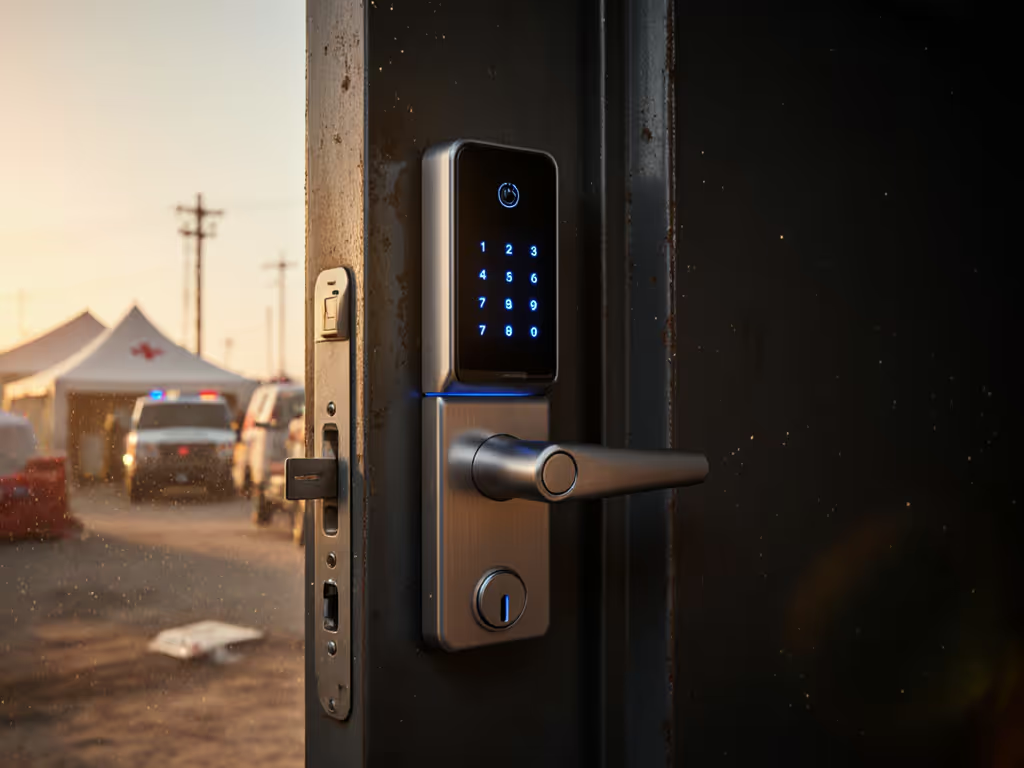
Disaster relief smart locks and temporary housing security systems address a critical blind spot in emergency response infrastructure. When humanitarian operations deploy makeshift shelters, distribution centers, or triage facilities, access control becomes both a security necessity and a logistical challenge, yet most smart lock deployments rely on cloud backends that may be inaccessible during and immediately after a crisis. This FAQ deep dive explores how local-control architectures, open standards, and documented protocols create resilient access systems for disaster response scenarios, where conventional infrastructure may be unavailable for days or weeks.
Foundational Questions
What makes smart locks suitable for disaster relief operations?
In disaster scenarios, security serves multiple purposes: protecting supplies, ensuring authorized access to restricted areas, preventing unauthorized entry during chaotic conditions, and maintaining clean handoff records for liability and accountability. Traditional mechanical locks lack auditability; temporary padlocks offer no remote management. Smart locks bridge this gap by enabling emergency shelter access control that is both auditable and remotely manageable without requiring internet connectivity.
Critically, relief operations involve rapid personnel rotation, visiting contractors, and NGO staff with varying tenure. Generating and revoking time-bound access codes for dozens of individuals manually is error-prone and slow. Smart locks with local management capabilities allow operations coordinators to issue codes with built-in expiry windows, revoke access instantly, and maintain cryptographically signed audit logs, all without cloud dependency.
Why is local control essential in disaster contexts?
Disaster scenarios frequently feature degraded or absent internet. Cell towers fall, fiber cuts occur, and emergency bandwidth is rationed for life-critical communications. A smart lock dependent on cloud connectivity becomes inert, locked or unlocked, but unmanageable. I learned this principle acutely when a client's home automation ecosystem simply went dark after a vendor shuttered its bridge service. All their carefully orchestrated flows (door unlocks, lighting sequences, automations) evaporated overnight. Because we'd anchored the deployment on Zigbee locks and documented local behavior, I rebuilt everything on a local controller within a weekend. That migration, born from necessity, became the template for every disaster-adjacent deployment I've designed since. The lesson: interoperate today, migrate tomorrow, and stay sovereign throughout. For disaster-specific safety configuration, see our disaster-ready smart locks guide.
In disaster relief, a similar failure is unacceptable. A locked supply tent when the coordinator's credentials expire mid-crisis is a security failure and an operational catastrophe. Local control (where the lock stores access policies, validates credentials, and maintains logs on-device) ensures continuity regardless of internet state.
Which protocols support resilient disaster response lock systems?
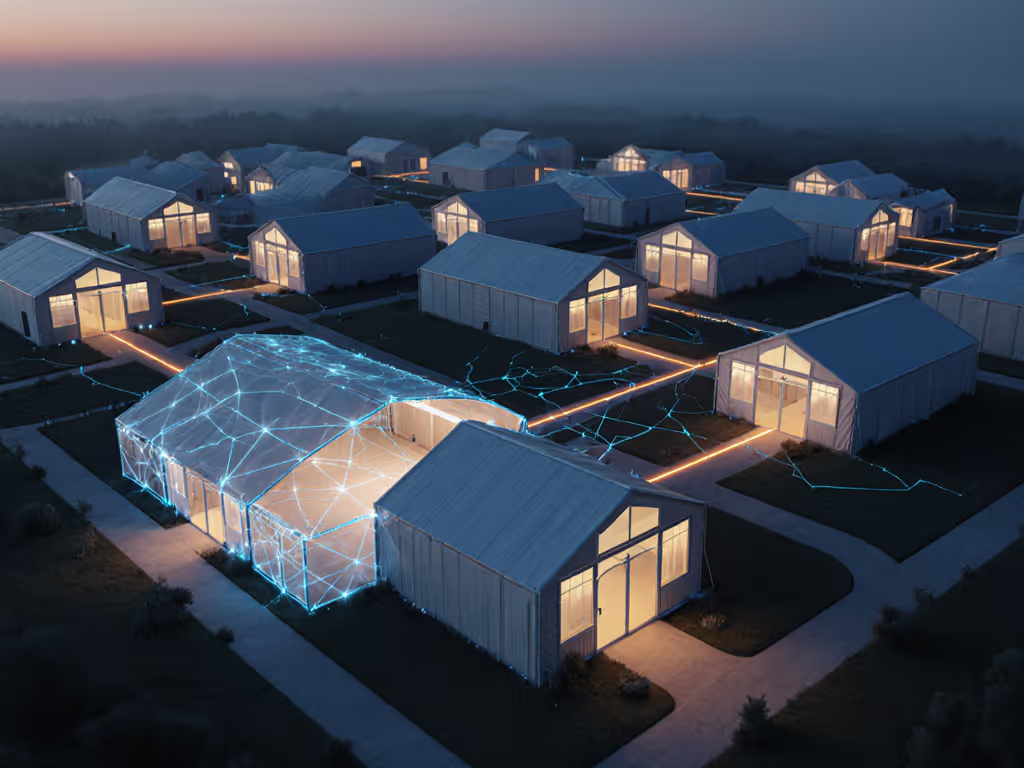
Disaster response lock systems benefit from mesh-capable, low-power protocols that do not require a commercial cloud service:
-
Zigbee: Forms self-healing mesh networks. Devices relay messages through neighbors, providing coverage without relying on a central hub or internet. Zigbee clusters define standardized command schemas (e.g., door locks implement the
DoorLockcluster), enabling plug-and-play interoperability. Critical for field-deployed scenarios where coverage is spotty. -
Z-Wave: Similar mesh architecture with smaller device ecosystems. S2 security introduces AES-128 encryption with key derivation, protecting against passive eavesdropping. Slower than Zigbee but robust in noisy RF environments.
-
Matter over Thread: An emerging standard that prioritizes local control and interoperability. Thread provides IPv6-based mesh over 802.15.4; Matter abstracts the hardware, allowing devices from different vendors to speak a common language. Requires a Thread Border Router to bridge to Ethernet, but that device can operate fully offline.
-
Bluetooth Low Energy (BLE) with Local APIs: Some locks advertise state and accept commands via local BLE, bypassing Wi-Fi and cellular entirely. Not mesh-capable, but effective for line-of-sight access at a shelter entrance.
Protocols over products: standardized, documented interfaces prevent vendor lock-in and ensure portability when operational needs shift or organizations rotate out. To choose the right radio for your deployment, compare options in our Z-Wave vs Wi-Fi vs Bluetooth guide.
How should humanitarian aid organizations approach access management?
Humanitarian aid security solutions must balance security rigor with operational simplicity. A relief coordinator managing 50+ temporary staff cannot afford complex user management:
-
Batch Access Creation: Allow time-bound codes generated in bulk (e.g., "Create 30 codes, each valid for 48 hours, for the meal distribution team"). Codes auto-expire; no manual revocation needed if not all are used.
-
Role-Based Access Levels: Designate roles (supply officer, medical staff, visitor) with pre-assigned zone access. Assigning someone to a role auto-populates their permissions without individual configuration.
-
Local Audit Export: All access events (who, when, success/failure) stored on the lock and exported to USB or local network for camp records. No cloud upload, data stays under organizational control.
-
Offline Revocation with Graceful Degradation: When internet is unavailable, locks continue to validate codes from their local database. Once connectivity restores, new revocation lists are pushed. Until then, old codes remain valid, acceptable for temporary deployments where re-authorization delays are tolerable.
-
Mechanical Bypass: Every lock must retain a physical key or emergency override (e.g., lever override or 9V emergency power port). Disasters test every assumption; redundancy is mandatory.
What role does encryption play in field deployments?
Encryption in smart locks serves two functions: preventing eavesdropping and ensuring code authenticity. Z-Wave S2 and Zigbee employ AES-128 for wireless traffic. However, symmetric encryption requires all communicating devices to share keys, a bootstrapping challenge in ad-hoc relief scenarios.
BLE advertising, by contrast, typically transmits in clear, but modern locks use BLE advertising only for presence/status beacons, not for credential exchange. Actual unlock commands are sent over authenticated, encrypted channels.
For disaster response, prioritize locks with:
- Pre-shared Commissioning: Keys are embedded during manufacturing or set during first pairing with a local hub. No cloud registration required.
- Documented Cipher Suites: Transparent, auditable encryption (not proprietary black boxes).
- Local Key Storage: Cryptographic material never leaves the device or is synced to cloud analytics services.
Unverifiable security claims ("military-grade encryption" without specifics) are red flags. Demand audit results, CVE response timelines, and change logs.
How do bridge vs. end-device architectures affect deployment resilience?
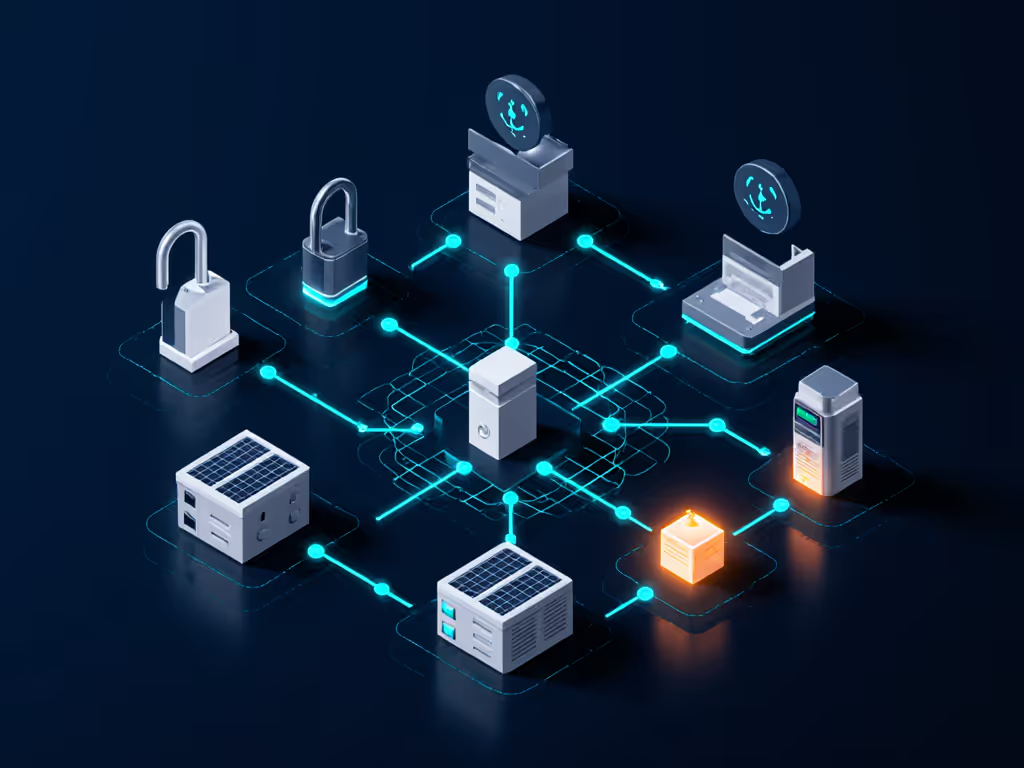
In mesh networks, bridge vs. end device roles define data flow:
- End Devices: Locks that originate commands (unlock, lock) but do not relay messages for others. Lower power consumption, simpler design, but require constant range to a repeater or hub.
- Repeater/Bridge Devices: Locks (or dedicated repeaters) that relay messages between end devices and the hub, extending coverage.
- Hub: Central coordinator that validates access policies, logs events, and provides local API.
For mobile housing security, end-device-only deployments are fragile. A shelter's door lock must communicate with the hub regardless of intermediate nodes' status. Deploying a mesh requires at least 2 to 3 repeater-capable devices (or dedicated repeaters) to ensure redundancy. If the only repeater fails, the mesh fragments.
Resilient disaster deployments therefore:
- Provision multiple mesh nodes (repeaters or coordinators) distributed across the shelter.
- Document which devices can relay; test mesh integrity before operations begin.
- Ensure hubs have local battery backup or solar charging for weeks of uptime.
- Train operators to recognize and respond to mesh fragmentation (e.g., door lock unresponsive after a storm damages a relay point).
Operational Considerations
How should relief coordinators onboard staff to the access system?
In high-chaos environments, user training must be minimal. Smart locks should:
- Accept Simple PIN Codes: No biometric setup, no app registration. A 4 to 6 digit code, available without internet, is the baseline.
- Support Physical Key Cards or NFC Tags: RFID-enabled locks allow cardholders to tap and enter. No screen, no app, no password memory required.
- Provide Clear Feedback: LED indicators (green = unlocked, red = denied) or audio cues eliminate ambiguity.
- Log All Attempts: Failed attempts are recorded; coordinators can audit rejection patterns (e.g., "Why are codes expiring before shift end?").
What redundancy should be designed into temporary shelter systems?
Disaster environments are inherently unpredictable. Single points of failure are unacceptable:
- Multiple Hubs: If the primary hub loses power or crashes, a secondary hub on battery backup takes over.
- Local Storage Replication: Access policies and audit logs are replicated across hubs or exported to USB drives for manual synchronization.
- Mechanical Backup Access: Every restricted door has a physical key held by the site director or security officer. Learn how first responders gain entry with firefighter entry protocols.
- Battery and Solar Backup: Smart lock batteries last 6 to 12 months under normal use; hubs should have 72 hours of battery or solar charging.
- Offline Code Validation: Locks validate codes against a locally stored, cryptographically signed policy file. Even if the hub is offline, valid codes unlock.
How should organizations handle code expiry and revocation?
Unlike permanent deployments, temporary housing has inherent churn. Staff are deployed for weeks, contractors for days. Expiry mechanisms prevent drift:
- Time-Window Codes: Each code is valid between specified start and end times (e.g., "Monday 6 AM to Wednesday 6 PM"). No manual revocation needed.
- Event-Triggered Revocation: When internet connectivity restores, the hub can push new revocation lists, invalidating codes of departed staff.
- Revocation Delay Tolerance: Expect 12 to 24 hour delays between revocation and local enforcement. Design access models (e.g., no critical door should rely solely on a 2-hour-old revocation list) with this in mind.
Future-Proofing Disaster Deployments
How can organizations ensure their smart lock deployments survive vendor changes?
Vendor consolidation, acquisitions, and service discontinuations are inevitable. Protect investments:
- Demand Open APIs and Documented Protocols: Locks with published, non-proprietary command schemas allow third-party hub software to support them. If the vendor shuts down, a new hub can take over.
- Export Audit Logs and Configurations: Ensure you can extract all access policies and event histories in non-proprietary formats (CSV, JSON).
- Avoid Proprietary-Only Bridges: Single-vendor hubs create lock-in. If the hub is discontinued, all locks become unmanageable. Prefer software hubs (open-source or multivendor) that can be migrated to new hardware.
- Subscribe to Standards Bodies: Participate in Matter or Zigbee Alliance updates to stay informed of protocol evolution and interop announcements.
What ongoing monitoring and maintenance should relief teams implement?
Temporary deployments require proactive oversight:
- Weekly Mesh Health Checks: Test communication between all locks and hubs. Replace failed repeaters before they fragment the network.
- Battery Audits: Check lock and hub battery levels weekly. Replace or recharge proactively; waiting for low-battery warnings in the field is risky. For model picks that minimize field swaps, see our best battery-life smart locks.
- Code Expiry Forecasting: Generate reports 2 to 3 days before mass code expirations. Reissue codes for extended-stay staff to prevent access denials.
- Audit Log Review: Sample access logs for anomalies (repeated failed attempts, unusual times). Escalate suspicious patterns.
- Documentation: Maintain a local binder with hub IP addresses, default credentials (for emergencies), mesh diagrams, and mechanic key locations. In a crisis, digital systems may be unavailable.
Deeper Exploration
Smart lock deployments in disaster relief represent a specialized but high-impact application of home automation principles. Organizations seeking to implement these systems should:
-
Engage vendors early: Request reference deployments in NGO or emergency management contexts. If a vendor cannot provide examples, they lack relevant experience.
-
Run sandbox tests: Before deploying to the field, operate the system offline for 2 to 4 weeks, simulating internet loss and power outages. Identify gaps and train operators.
-
Audit security posture: Request third-party penetration test results. Verify that encryption is standards-based (AES-128, not proprietary), and that the vendor responds to CVEs within 30 days.
-
Plan handoff procedures: Document the process for transitioning the deployment to subsequent response phases (e.g., from emergency shelter to long-term temporary housing). Ensure that access policies, audit logs, and credentials can be securely transferred.
-
Build community: Connect with other relief organizations using smart locks. Share lessons learned, recommend vendors, and collectively pressure the industry for interop improvements.
The stakes in disaster response are human safety and operational integrity. Choosing architecture that prioritizes local control, open protocols, and verifiable security is not just a technical preference, it is a commitment to resilience when it matters most.
Related Articles