3D Facial Recognition Smart Locks: How Spoofing Prevention Works
By Kenji Sato • 2nd May
Introduction
3D depth mapping facial recognition locks represent a significant leap in biometric security for entryways. Unlike older camera-based systems, modern face recognition smart locks now employ depth sensors and anti-spoofing protocols to resist attacks that plagued earlier generations. If you're evaluating biometric entry systems (especially for rental properties, multi-unit managers, or high-privacy homes), understanding the technical underpinnings of spoofing prevention is essential. This FAQ deep dive examines how 3D facial recognition defeats spoofing, how different sensing modalities compare, and what open-standards considerations matter most for long-term resilience.
How Spoofing Attacks Work Against Facial Recognition
Q: What exactly is spoofing in the context of facial recognition locks?
Spoofing is any technique that tricks a facial recognition system into authenticating an impostor. Early systems were vulnerable to:
- Photo attacks: A printed photo of the authorized user held up to the camera
- Video playback attacks: A recorded video of the authorized face displayed on a screen
- Mask attacks: Silicone or 3D-printed masks of the target face
- Deepfake attacks: AI-synthesized video of the authorized person
A client once deployed a system that accepted any face within 70% pixel similarity to an enrolled photo. Within a week, their neighbor gained entry using nothing more than a high-resolution screenshot printed on glossy paper. That lock was offline-only (a privacy win), but its spoofing defenses were nonexistent. When facial recognition failed them, they lost confidence in the entire biometric modality. When a vendor killed its bridge, another client's automations died overnight. If you're weighing connectivity trade-offs, see our Z-Wave vs Wi-Fi vs Bluetooth guide. Because we'd chosen Zigbee locks with documented flows, I rebuilt everything on a local controller in a weekend. That experience taught me: spoofing prevention without verifiable depth verification remains a cosmetic security layer.
How 3D Depth Mapping Defeats Spoofing
Q: How does 3D depth mapping prevent spoofing attacks?
3D depth mapping facial recognition adds a spatial dimension that 2D cameras cannot replicate. Here's why it matters:
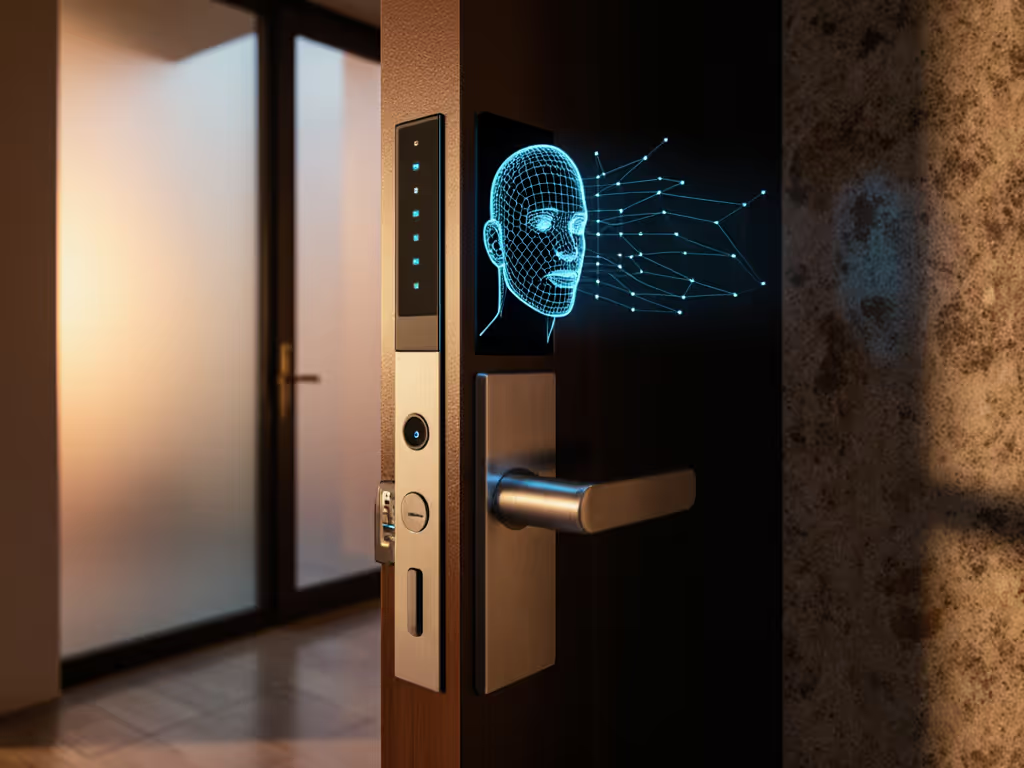
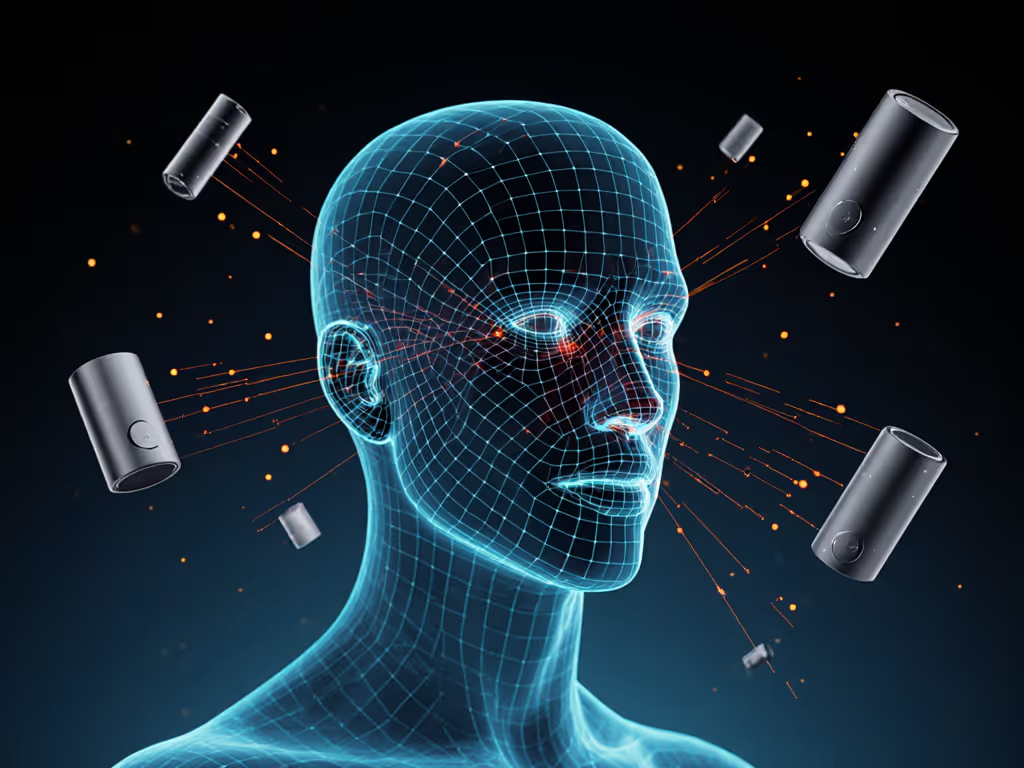
- Structured light projection: The lock emits a known infrared pattern and measures how it deforms across the face's surface. A printed photo reflects the light uniformly; a real face creates unique distortions.
- Depth profile verification: The system captures not just the front-facing geometry, but the curvature of cheekbones, nose bridge, chin, and ear contours. Masks and photos cannot reproduce these micro-variations with sufficient accuracy.
- Liveness detection: By analyzing how the face moves and how depth changes with subtle facial expressions, the system confirms a living, responsive person is present, not a static replica.
- Temporal analysis: Anti-spoofing logic examines frame-to-frame consistency. A video playback or mask will show artifacts, jittering, or reflection patterns that differ from genuine facial movement.
When depth information is captured and verified locally on the lock's processor (not sent to the cloud for analysis), the latency is negligible and the processing happens in the device's security enclave. This is a win for both speed and privacy.
2D vs. 3D Facial Recognition: Technical Comparison
Q: What's the practical difference between 2D and 3D facial recognition in smart locks?
| Aspect | 2D RGB Camera | 3D Depth Mapping |
|---|---|---|
| Spoofing Vulnerability | High: photos, videos, masks defeat it | Very low: requires authentic 3D structure |
| Lighting Dependency | High: needs good ambient light | Moderate: infrared is independent of ambient light |
| Processing Speed | Fast: simple feature extraction | Slightly slower: depth calculation overhead |
| Offline Capability | Possible, but riskier | Ideal: depth verification is localized |
| Privacy Implications | Face templates often cloud-synced | Can be processed and discarded locally |
| Cost & Power | Low power, cheaper | Higher power draw; infrared LED cost |
| Failure Modes | False positives (spoofed entry) | False negatives (rejection of legitimate faces) |
The trade-off is clear: 3D depth adds detection overhead and battery drain, but it eliminates the spoofing surface area. For high-security applications and privacy-conscious deployments, that trade-off is non-negotiable.
Infrared Facial Mapping and Thermal Imaging
Q: Are infrared facial mapping and thermal imaging security locks the same?
No, and this distinction matters significantly for spoofing resilience:
- Infrared active structured light (3D mapping): The lock projects an infrared facial mapping pattern and analyzes reflections to compute depth. The infrared light itself doesn't convey temperature information (it is purely geometric). This approach is what most modern anti-spoofing systems use.
- Thermal imaging security locks: A thermal camera measures heat signature. It can detect living tissue by its warmth, which is a liveness indicator. However, thermal imaging alone is not sufficient for facial recognition, as it cannot reliably distinguish between authorized and unauthorized persons.
Hybrid systems combine both: structured light for 3D geometry and thermal for liveness. This raises the attack barrier significantly. A mask of sufficient quality might defeat 3D depth verification alone, but it cannot replicate authentic thermal signature. For a side-by-side look at face, fingerprint, and vein options, read our biometric door lock comparison.
Offline Processing and Local Privacy
Q: How does offline processing affect spoofing prevention?
When facial recognition processing happens locally on the lock, two benefits emerge:
- No cloud latency: The spoofing-detection logic executes in milliseconds on the device's secure processor. Cloud-dependent analysis introduces lag and a network dependency.
- Enrollment data stays local: The enrolled face template is stored in the lock's secure enclave, never uploaded. Even if the network is compromised, the biometric profile is not exposed. This is the gold standard for privacy-preserving facial recognition. To harden local setups, follow our offline security and encryption guide.
However, local processing is only secure if the enrollment process is also documented and reproducible. A lock that requires a proprietary phone app to enroll faces, sends that enrollment over an unverified connection, or stores templates in an undocumented format is not truly offline-first. Test cold starts and power cycles; ensure the lock re-authenticates correctly after a factory reset and that enrollment survives a power loss.
Standards and Interoperability
Q: What role do open standards play in facial recognition lock security?
This is where the argument becomes strongest: spoofing prevention is only trustworthy if the anti-spoofing mechanism is transparent and independently verifiable.
Current facial recognition smart locks use proprietary algorithms, often undisclosed. No third party has audited the depth-detection logic, the threshold for accepting a face, or the liveness-detection heuristics. This means:
- You rely entirely on the vendor's security claims, which are difficult to verify.
- When a vendor's product is discontinued or the company is acquired, the anti-spoofing mechanism may be abandoned or downgraded for cost reasons.
- No export path exists: if the lock is stolen or physically compromised, you cannot transfer your enrollment data or anti-spoofing configuration to another device.
Interoperate today, migrate tomorrow, and stay sovereign throughout.
If facial recognition smart locks adopted open anti-spoofing standards (standardized depth-detection thresholds, documented liveness criteria, exportable enrollment data), then users could switch between vendors without re-enrolling and security researchers could audit the mechanisms independently.
Some locks do publish structured behavior specifications for Matter or Thread integration, which is a step forward. For a deeper dive into Matter protocol for smart locks, see our dedicated guide. But the biometric core remains a black box.
Comparing Products: Apple HomeKit and Ultraloq U-Bolt Pro WiFi
Q: How do specific products compare on spoofing prevention?
Apple HomeKit face recognition uses Secure Enclave processing on compatible iPhones and Apple Home hubs, which is transparent and auditable by Apple's security team. However, HomeKit integration with third-party locks is limited; most HomeKit locks rely on keypads or cards, not built-in facial recognition. This is partly because HomeKit's architecture emphasizes interoperability, and proprietary biometric systems would fragment that ecosystem.
Ultraloq U-Bolt Pro WiFi uses infrared facial mapping but relies on WiFi connectivity and proprietary app enrollment. The anti-spoofing claims are not independently verified. The lock does support local control when WiFi is available, but enrollment and liveness-detection algorithms are not disclosed. This is the norm for commercial locks, but it limits your ability to verify the spoofing-prevention rigor.
For property managers and renters, the question becomes: do you prioritize the ecosystem (HomeKit, Home Assistant) or the anti-spoofing rigor? Few products offer both. This is a genuine gap in the market.
Privacy and Data Retention
Q: What privacy risks remain even with 3D facial recognition?
3D depth alone does not guarantee privacy. Consider:
- Enrollment data: Where is the face template stored? If cloud-synced, the vendor has a permanent biometric record.
- Access logs: Does the lock log which face was recognized at which time? If yes, and logs are cloud-synced, the vendor learns your access patterns.
- Update vectors: Does the lock allow firmware updates over the internet? Unsigned firmware is a vector for backdoor injection of anti-spoofing bypasses.
The most privacy-preserving approach is:
- Enroll faces locally, on the lock or via local hub.
- Store templates in a tamper-resistant enclave.
- Keep access logs local; never transmit them without explicit consent.
- Use firmware signatures and allow rollback to previous versions if a security issue is discovered.
This is rare among commercial locks. Before choosing a model, review smart lock data ownership and access logs. Most require cloud accounts, and many default to transmitting logs and enrollment data unless explicitly disabled.
Further Exploration
Spoofing prevention in facial recognition locks is technically sound but commercially opaque. As you evaluate options, prioritize:
- Verifiable anti-spoofing mechanism: Seek locks with published research, third-party security audits, or participation in recognized standards bodies.
- Local processing and offline resilience: Test the lock's behavior on WiFi loss and power cycles. Ensure enrollment data is not dependent on cloud connectivity.
- Transparent enrollment and data handling: Understand where your biometric data lives, how long it persists, and whether you can export it.
- Open API and interoperability roadmap: Ask vendors if they plan to support standardized face-recognition data formats or open biometric standards.
- Graceful fallback modes: Does the lock work with mechanical keys or a secondary code-based entry if facial recognition fails? Spoofing protection is useless if the alternative is being locked out.
For renters and rental hosts, facial recognition remains risky because enrollment is often per-person and enrollment data may not be portable between instances or properties. Keypads and time-limited codes still offer clearer governance and fewer privacy vectors, and they are already standards-compliant.
Continue researching vendor security postures, test any system in your own space before committing to a deployment, and remember: interoperability is your insurance policy against vendor lock-in. A lock that supports Matter, local APIs, and exportable configurations may cost more upfront, but it is the only path to sustainable, future-proof access control.
Related Articles